

Climate Action
Policy/Basic Concept
“Climate change” is one of the most important social challenges which the global community is facing. The adverse effects of climate change are becoming more noticeable in many parts of the world and have become a serious issue influencing not only natural disasters, but also food production and economic security. Companies are expected to step up their efforts to decarbonize their operations in response to climate change. The Ricoh Group's concept of a sustainable society is expressed in the “Three Ps Balance,” which describes a society that maintains a balance among the three Ps: economy (Prosperity), society (People), and the global environment (Planet).
 Three Ps Balance
Based on the Ricoh Group Environmental Declaration, which states “We proactively reduce environmental impact and strive to improve the Earth’s self-recovery capabilities to achieve a zero-carbon society and a circular economy through business.” we have positioned the realization of a decarbonized society as one of our materiality issues in the global environment field. We are engaged in activities to reduce our GHG emissions to achieve the targets for reducing GHG emissions established through back casting, while respecting scientific findings such as those of the IPCC and international agreements like the Paris Agreement.
Decarbonization Policy
1.Conserve energy and switch to alternative fuels.
2.Harness renewable energy.
3.Identify and reduce GHG emissions in the supply chain.
For details of Ricoh group's climate change activities, please refer to the following report.
Ricoh Group Environmental Report
Structures/Systems
To continuously discuss mid- to long-term issues of the Ricoh Group in the areas of environment, society, and governance at the management level, the ESG Committee, chaired by the CEO, was established in May 2018. The committee meets once every quarter with the participation of Senior Management to discuss the status of initiatives, issues, and investment decisions related to ESG themes, such as zero carbonization, as important themes for management. Its deliberations are regularly reported to the Board of Directors, which then supervises the execution of ESG activities at a high level.
In addition, we set a target for reducing GHG emissions as one of the companywide ESG targets established as part of our mid-term management strategy, and at the same time, we set a target for reducing GHG emissions for each business unit, for which we conduct forecast and performance management for each business year. We analyze environmental performance data compiled by our cloud system for our approximately 900 global sites and use this data for PDCA management.
Targets and Performance
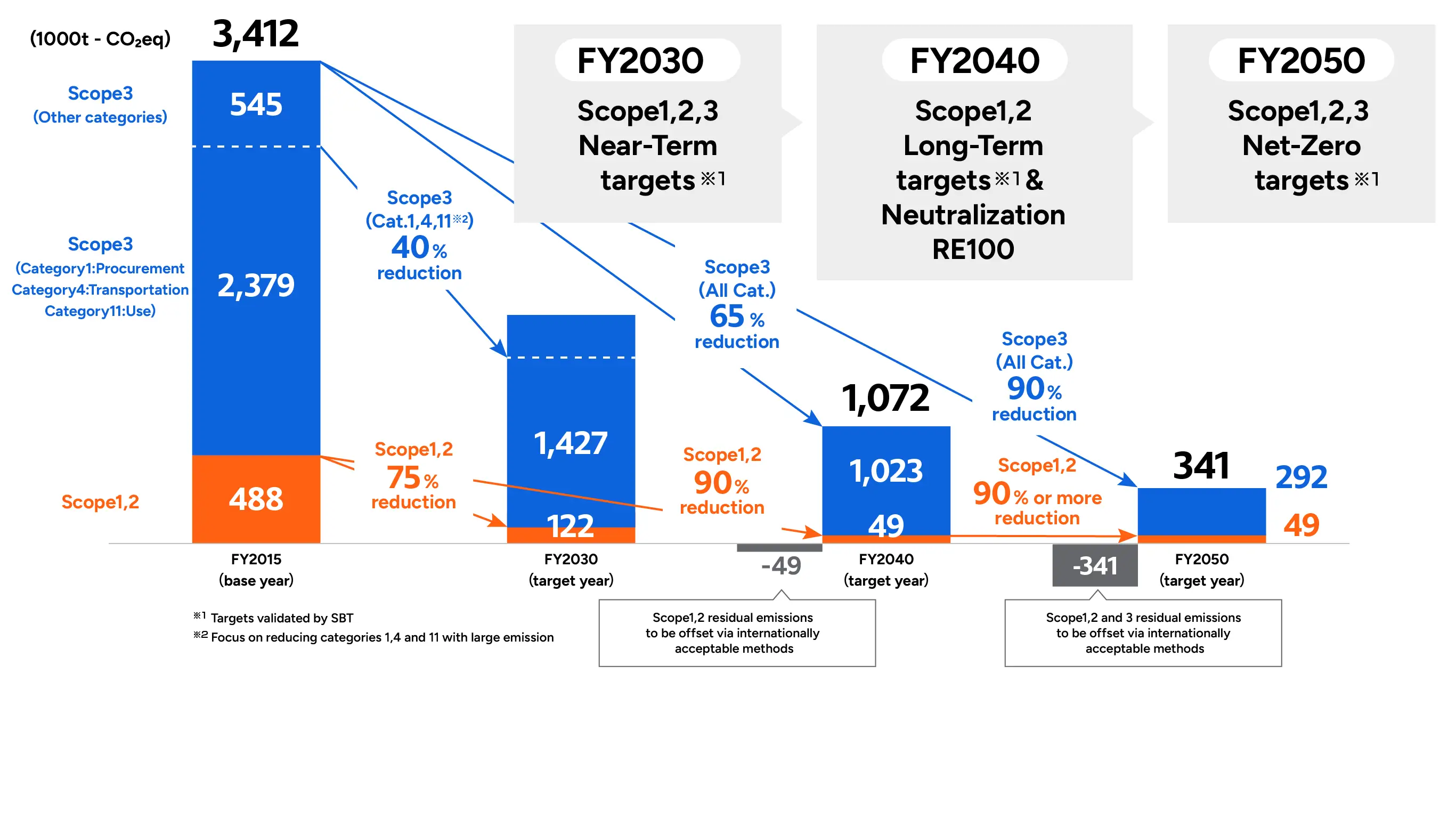
The Ricoh Group aims to achieve net zero GHG emissions by 2050. Together with our near-term target of reducing GHG emissions in Scope 1, 2 and 3 by 2030 and our long-term target of reducing GHG emissions in Scope 1 and 2 by 2040, our net zero GHG emissions target has have been validated by the Science Based Targets initiatives (SBTi) as aligned with the Paris Agreement’s 1.5°C pathway. Moreover, we aim to achieve 100% renewable energy ratio for the electricity used in our business activities by 2040.
Ricoh Group Environmental Goals (zero-carbon)
|
Target Year |
GHG Emissions Reduction Rate and Status |
Renewable Energy Usage Ratio (Electricity) *1 |
|
|---|---|---|---|
| Scope 1,2 | Scope 3 | ||
| 2030 | 75%*2 |
40%*2 (Category 1, 4 and 11) |
85% |
| 2040 |
90%*2 Neutralized*3 |
65% (All Categories) |
100% |
| 2050 | 90% or more |
90%*2 (All Categories) |
ー |
| Scope 1,2,3 Net Zero*2,3 | |||
All GHG emissions reduction rates are compared to 2015 level.
- GHG Scope 1:All direct GHG emissions from our manufacturing plants, offices, vehicles, etc..
- GHG Scope 2:Indirect GHG emissions from the generation of electricity and heat that we purchase.
- GHG Scope 3:GHG emissions in our supply chain. (except GHG Scope 1 and 2 emissions)
- *1:Compliant with RE100 Technical Criteria
- *2:Validated by Science Based Targets initiative (Near-Term Criteria v5.3 and Net-Zero Criteria v1.3)
- *3:Residual emissions to be offset via internationally acceptable methods
GHG Scope 1 and 2 reduction
Harness renewable energy
- Purchase of renewable energy
- In-house renewable energy power generation
- Introduction of PPA contracts
- Strategic utilization of renewable energy certificates
Conserve energy and switch to alternative fuels
- Innovation of production and business processes
- Installation of highly efficient and energy saving equipment
- Electrification of production process and fuel conversion
- Promotion of Net Zero Energy Buildings
- Operational innovation of corporate fleet vehicles and electrification
GHG Scope 3 reduction
Decarbonization in the supply chain
- Zero-emission material procurement
- Development of energy-saving equipment, introduction of renewable energy by customers
- Use of non-fossil fuel-based transportation
- Use of non-fossil fuel-based services
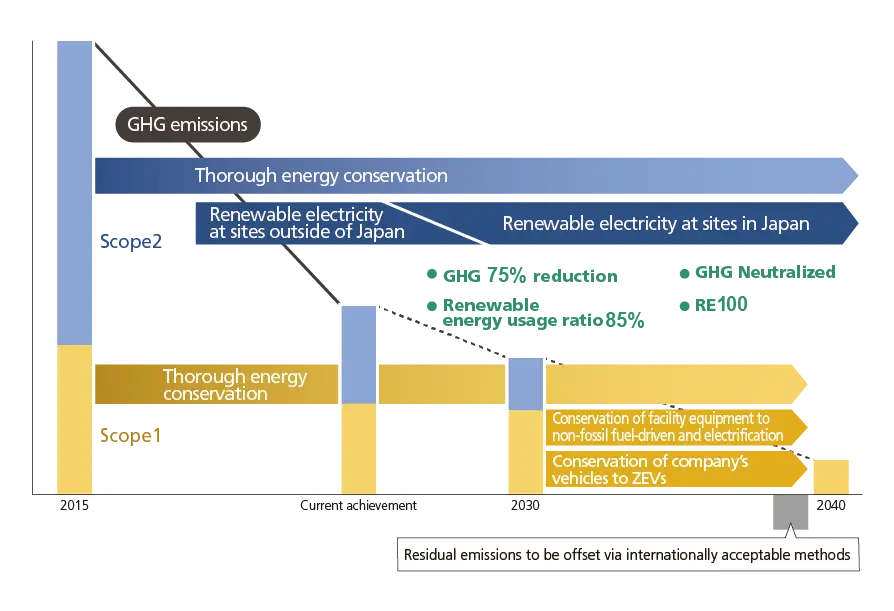
GHG Scope 1 and 2 reduction
Active and effective use of renewable energy
- Purchase of renewable energy
- In-house renewable energy power generation
- Introduction of PPA contracts
- Strategic utilization of renewable energy certificates
Energy saving and fuel conversion
- Innovation of production and business processes
- Installation of highly efficient and energy saving equipment
- Electrification of production process and fuel conversion
- Promotion of Net Zero Energy Buildings
- Operational innovation of corporate fleet vehicles and electrification
GHG Scope 3 reduction
Decarbonization in the supply chain
- Zero-emission material procurement
- Development of energy-saving equipment, introduction of renewable energy by customers
- Use of non-fossil fuel-based transportation
- Use of non-fossil fuel-based services
| Performance |
GHG Scope 1,2
GHG Scope 3
Electric power
|
|---|
*Due to changes to the Ricoh Group's organizational structure and improved data accuracy, we revised the past data
*Figures in this table to be updated with FY2025 result
Road Map for Zero-Carbon Society to Achieve 2030 Targets
2030 Scope 1, 2: Initiatives and plans to achieve 75% reduction
Active use of renewable energy
We will promote purchasing renewable electricity certificates and introducing on-site PPAs, and aim to complete the
transformation to RE100 by 2030 in overseas countries. In Japan, we will cooperate with like-minded companies to
lobby the government to reduce the cost of renewable energy, and we will diversify procurement methods to accelerate
the introduction of renewable energy. Furthermore, we will simultaneously promote responsible renewable energy
procurement that does not cause environmental damage or apprehension in local communities.
Promoting energy saving activities
We will promote improvement of manufacturing processes, introduce high-efficiency and energy-saving equipment, and
electrify facilities at our production sites. At non-production sites, in Japan, we will expand the number of ZEB
office buildings, and at overseas sites, we will promote the office relocation to energy-efficient offices. As for
company vehicles, we will work to ensure that all company vehicles are driven in an environmentally friendly manner,
and we will promote the conversion to Electric Vehicles (EVs), Fuel Cell Vehicles, and other energy-saving vehicles.
Additionally, we will address Scope 1 issues where electrification is challenging, such as using steam from boilers,
and strive to introduce future technologies like hydrogen.
<Expected reduction by activity towards FY2030 (starting from FY2024)>
*The figures in diagram below are based on fiscal year 2025 when the target was set, and revisions to past year's emissions due to subsequent organizational changes within the Ricoh Group are not reflected.
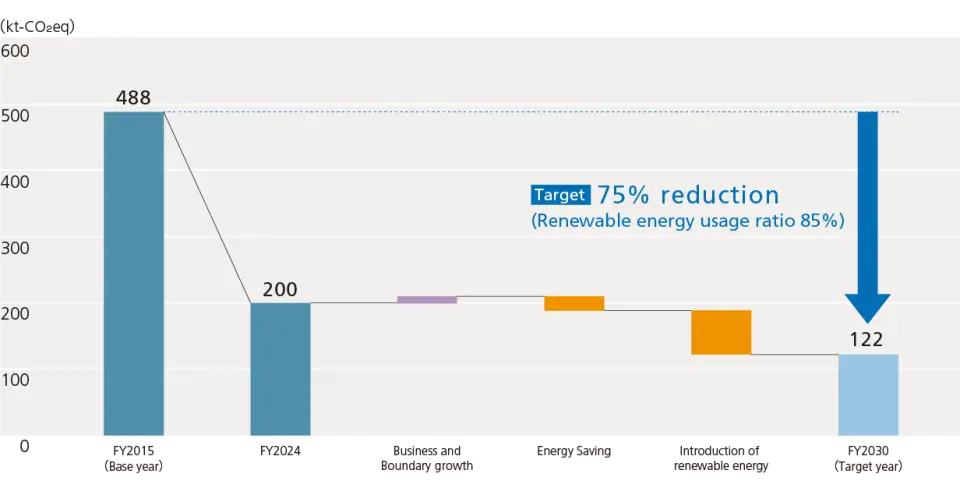
<Scope 1 and 2 Reduction Roadmap>
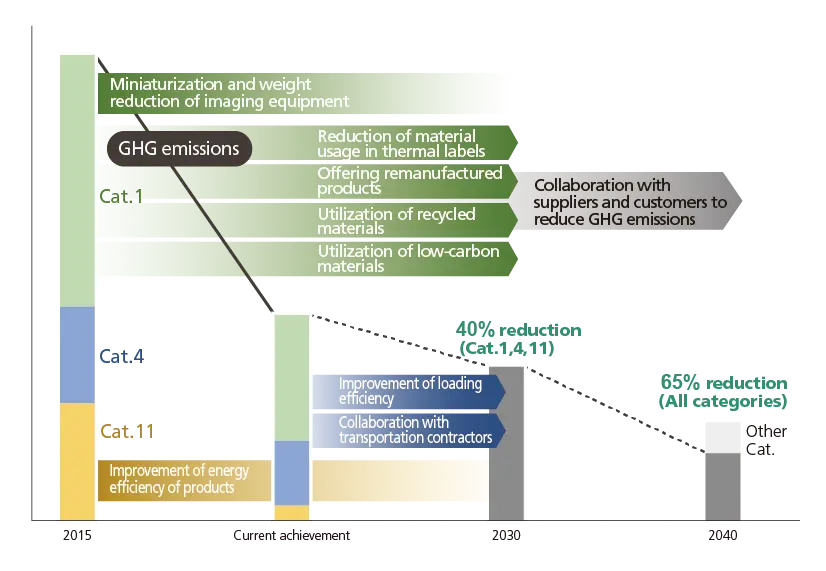
2030 Scope 3: Initiatives and Plans for 40% Reduction
We will work together with the entire value chain, including suppliers, customers, and transportation contractors, to achieve a Scope 3 reduction.
*The figures in diagram below are based on fiscal year 2022 when the target was set, and revisions to past year's emissions due to subsequent organizational changes within the Ricoh Group are not reflected.
Scope3 reduction scenario for 2030
<Expected reduction by activity towards FY2030 (starting from FY2022 when the target was established)>
*The figures in diagram below are based on fiscal year 2022 when the target was set, and revisions to past year's emissions due to subsequent organizational changes within the Ricoh Group are not reflected.
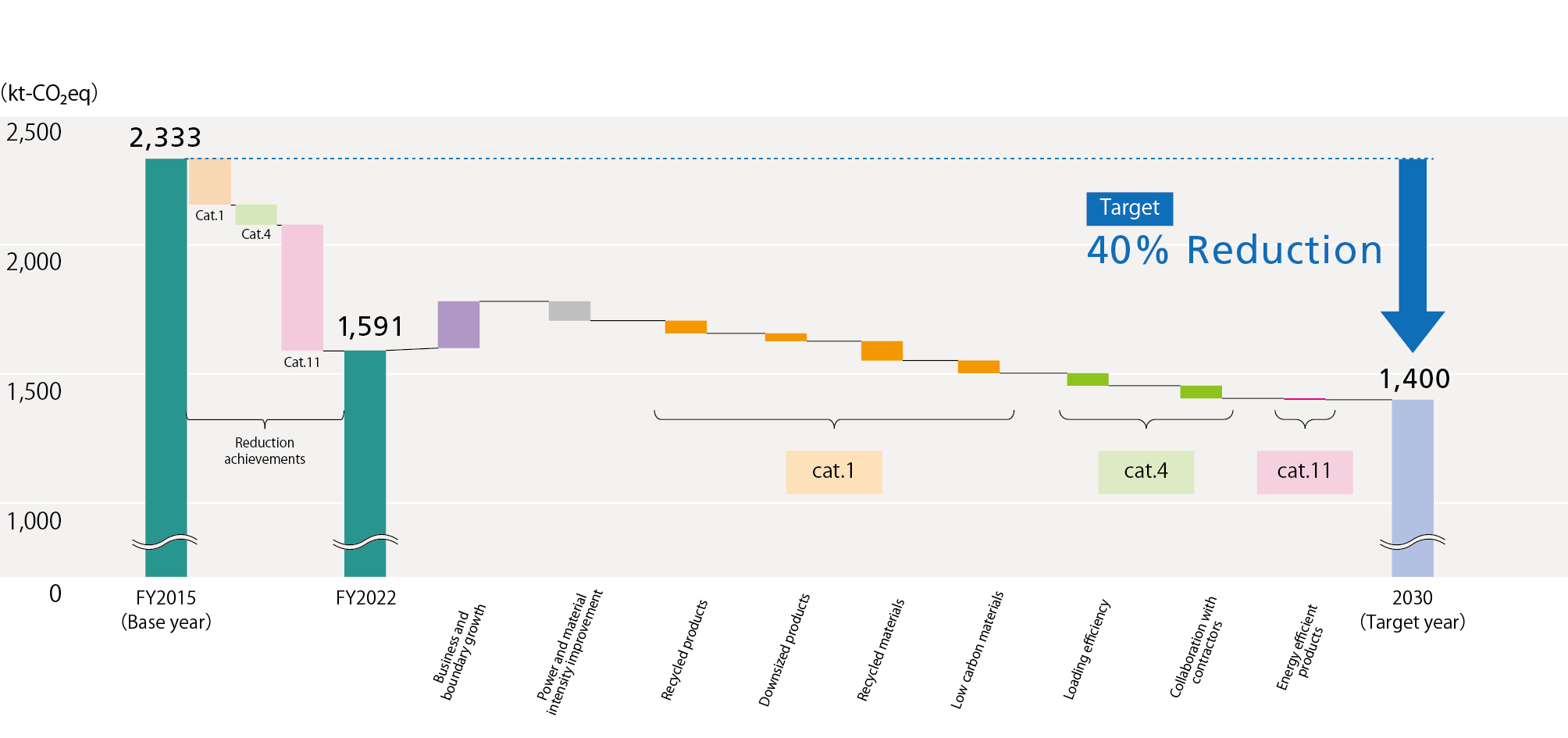
<Scope 3 Reduction Roadmap>
Avoided emissions
The Ricoh Group calculates the GHG emissions (Scope 1, 2 and 3) from its own business activities and sets environmental targets to reduce these emissions. On the other hand, GHG emissions increase with business growth and entry into new businesses. However, for example, society's GHG emissions can be reduced by improving the energy-saving performance of newly developed MFPs, reducing their power consumption and replacing older models, and the digital printing presses that Ricoh is aiming to expand sales of meet the market needs for high-mix, low-volume lots, and can save resources and energy by reducing inventory compared to conventional offset printing presses, resulting in a reduced environmental impact on society as a whole. Thus, the greenhouse gases reduced in society by Ricoh's products and solutions are referred to as "Avoided Emissions".
Target:1,400 kt-CO2eq (End of FY2025)
Performance:
|
FY2021 |
FY2022 |
FY2023 |
FY2024 |
||
|---|---|---|---|---|---|
|
Provision of energy saving products |
Amount (CO2 equivalent) reduced through the introduction of models to customers' sites with enhanced energy-saving functions for MFPs, printers and other equipment as well as lighting and air-conditioning control systems. |
197 | 226 | 240 | 114 |
|
Resource saving of products |
Amount (CO2 equivalent) reduced associated with procurement of raw materials and parts by lowering the input of new resources as a result of promoting reuse of recovered equipment, use of recycled materials, production of more compact, lightweight models, and use of ecological. |
74 | 67 | 65 | 79 |
|
Provision of digital services |
Amount (CO2 equivalent) reduced through the introduction of energy efficient solutions/services to customers' sites, including conversion from offset printing to digital printing and duplex and with suppliers. |
762 | 752 | 754 | 1,255 |
|
Total (1,000t-CO2eq) |
1,033 | 1,045 | 1,059 | 1,448 | |
For other achievements related to realizing a Zero-Carbon Society, please see below.
ESG data.
Initiatives

Initiatives for Scope 1 and 2 emissions reduction
【Harness renewable energy】
- Signing of VPPA and strengthening of adoption of renewable energy, with focus on supplementary potential
- Promote implementation of on-site PPA model at production sites
- Implementation of 100% renewable energy at A3 Multifunction Printer production sites worldwide
- Introduction of Comprehensive Evaluation System for Renewable Electricity
- Expansion of renewable energies usage at sites
【Conserve energy and switch to alternative fuels 】
- Installation of Waste Heat Recovery Heat Pumps at Production Sites
- Establishment of global standard for promoting sustainable real estate
- Expansion of ZEB Office Buildings and Application to Business Proposals for Customers
- Expansion of Environment-friendly buildings
Initiatives for Scope 3 emissions reduction
- Strengthening of activities to promote the use of life cycle assessments (LCAs)
- Reduction measures in marine transport
- Products contributing to society’s decarbonization
-
Energy saving and energy creation businesses (Japanese)